Statistics is given much more coverage as learners move into high school. In the earliest days, the topic is as much about pictures and presentation as in-depth analysis of numbers.
Initially, learners will learn to interpret and construct simple pictograms, tally charts, block diagrams, bar charts, pictograms, and tables.
They will record, interpret, collate, organise and compare information. Statistics encourages learners to combine from other areas of maths. For example, when reading and plotting many-to-one correspondence in pictograms.
Pictograms
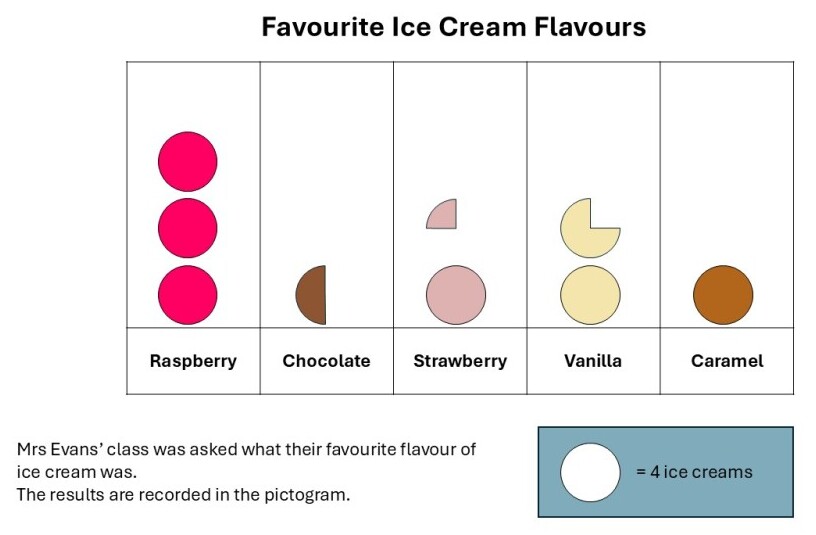
Here, one image may be used to represent several data. For example, in the pictogram shown, the quantities of different ice cream flavours are shown by circles or parts of a circle. Here, a whole circle represents four ice creams. Learners need to know their four times table and understand quarters.
In the pictogram below, the number of raspberry ice creams is represented by three whole circles. This is a total of 12 (3 x 4 = 12).
The count of 3 is shown by three-quarters of a circle. For vanilla ice cream the total is 4 + 3 or 7.
The ratios* used will be age-appropriate. That is to say that, as learners become more comfortable with times-tables knowledge, the range of these ratios will increase.
*i.e. the number of items measured by one symbol
They will also work with both discrete and continuous data, presenting it through appropriate graphical methods such as bar charts and time graphs. Additionally, they will complete, read, and interpret information in tables, including timetables, and develop the ability to interpret and construct pie charts and line graphs to solve problems.
Students will develop skills to ask and answer simple questions by counting objects in each category and sorting them by quantity. They will also solve one-step and two-step problems, such as “How many more?” or “How many fewer?” using data from scaled bar charts, pictograms, and tables. Additionally, they will tackle comparison, sum, and difference problems using information from bar charts, pictograms, tables, and other graphs, including line graphs.
Ask and answer questions about totalling and comparing categorical data
This is a relatively early skill for learners. Using pictograms with one-to-one or many-to-one correspondences, they can master the ability to interrogate and interpret data and understand how items can be grouped.
This presents a great opportunity for learners to talk maths as they decide how to group items. It’s also an early opportunity to meet and become familiar with factors and multiples, and even fractions, as they decide how many each picture or symbol will represent.
Calculate and interpret the mean as an average
In later maths, learners become familiar with the three forms of average: mean, median and mode. For now, they are introduced to the mean average. This is the traditional form of average most commonly referred to.
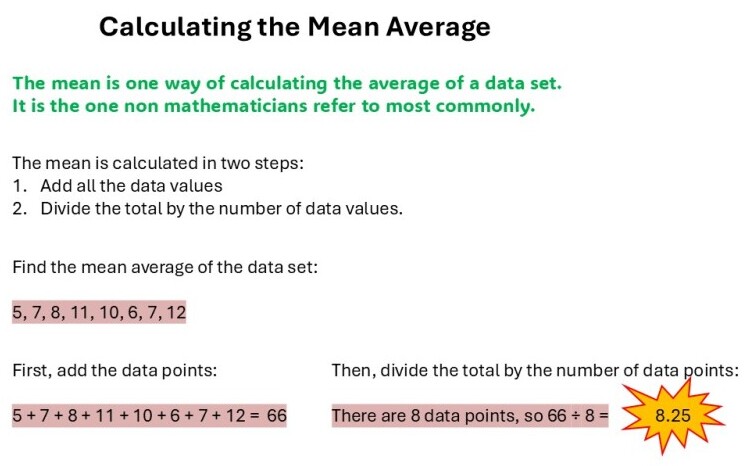
The mean is calculated in two steps. First, all the data points are added together. This total is then divided by the number of data points.
So there you are. A brief run-through of primary statistics.